medtests.net · Fatty liver
Fatty Liver Test
Established lab scores for two questions. FLI and HSI estimate signs of liver fat. FIB-4, APRI, and NFS estimate signs of possible scarring. Instant result, no sign-up, not a diagnosis.
Fatty liver calculator
Your values
FLI and FIB-4 are the main scores. Below, you can add HSI, APRI, and NFS as extra lab scores. All values are guidance. They are not a diagnosis or a treatment recommendation.
Steatosis signals
Enter all five values to calculate the FLI.
Fibrosis signals
Optional. FIB-4 also needs AST, ALT, and platelets from your blood test. Without these values, the FLI above is enough.
Enter age, AST, ALT, and platelets.
HSI adds to the steatosis question. APRI and NFS add to the fibrosis question. These scores share inputs such as BMI, AST, ALT, and platelets and are not diagnostic tools.
- you have raised liver enzymes, yellowish skin or eyes, or pain in the upper right abdomen
- you have type 2 diabetes, clear excess weight, or high blood lipids
- you drink alcohol regularly or take medications that strain the liver
A low value is no reason to put off a doctor's visit. This calculator can prompt a checkup, but it never replaces an exam.
FLI, HSI, FIB-4, APRI, and NFS are published screening and lab scores, not a diagnosis. Your entries stay in your browser and are not stored or sent.
What is a fatty liver?
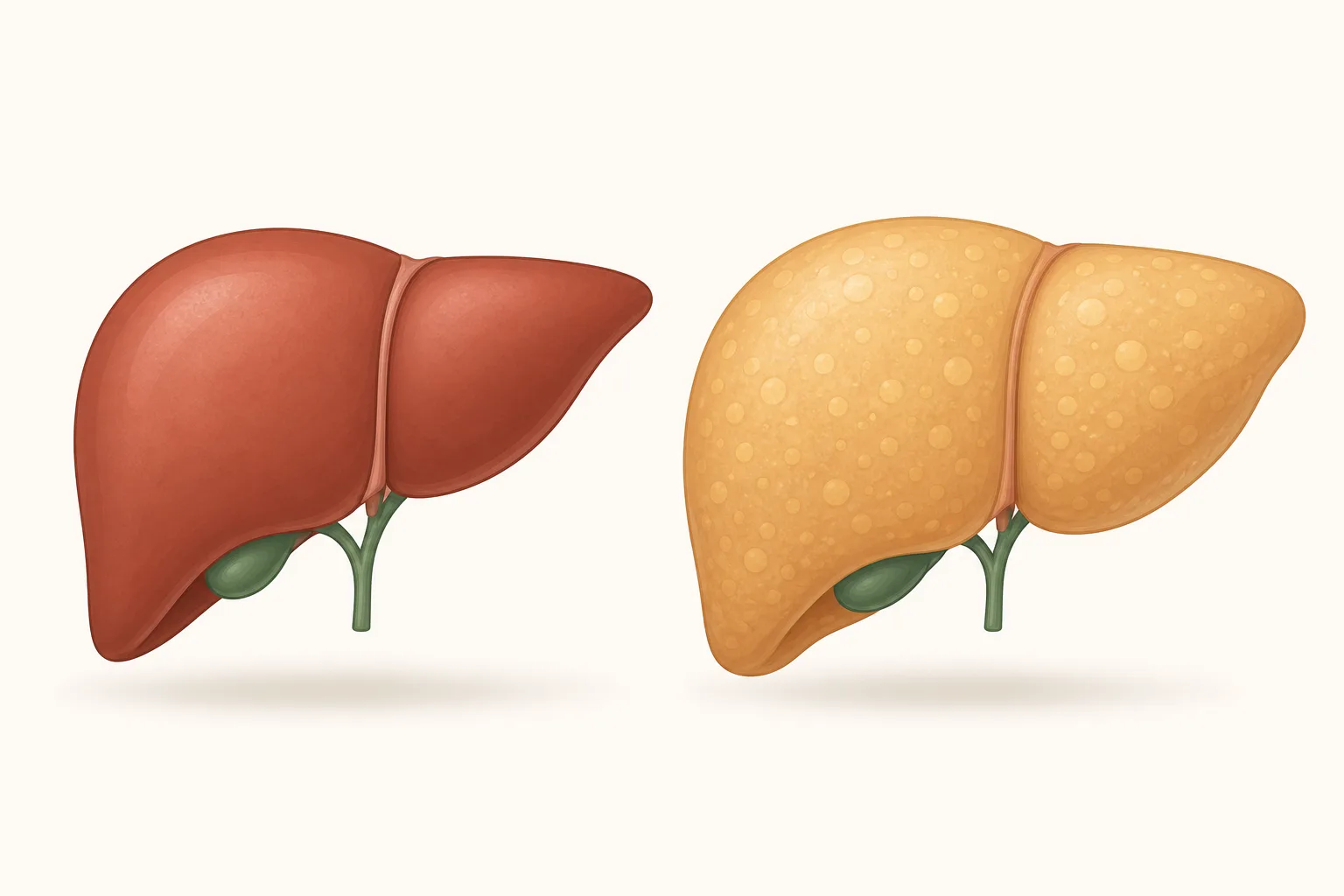
With a fatty liver (steatosis), the liver stores too much fat. The most common form is linked to metabolism and diet and is now called MASLD. For a long time it does not hurt and often goes unnoticed. Left untreated, it can become inflamed and the liver can scar. That is why two questions matter. Is fat stored in the liver (FLI), and is the liver already scarred (FIB-4)?
The five drivers
A fatty liver rarely has a single cause. Usually five factors work together, namely a Western-style diet high in sugar and fructose, insulin resistance, belly fat, disturbed fat metabolism, and silent, ongoing inflammation. The fatty liver is often the first visible sign, before insulin resistance, metabolic syndrome, and type 2 diabetes follow. The good news is that, based on current knowledge, an early-stage fatty liver can often reverse when you work on these drivers, mainly through diet, exercise, and weight.
Which lab values count
The key values are GGT, the liver enzymes ALT and AST and their ratio, triglycerides, HOMA-IR as a measure of insulin resistance, and waist size. The calculator above uses these standard values. GGT, triglycerides, and waist go into the FLI. AST and ALT go into FIB-4, HSI, APRI, and NFS. A single raised value does not prove a fatty liver, but the pattern gives you solid ground for the talk with your doctor.
Steatosis or fibrosis, what measures what?
Estimates whether fat is stored in the liver at all. From BMI, waist, triglycerides, and GGT. Range 0 to 100.
An additional sign of steatosis. From BMI, ALT/AST, sex, and diabetes status. Do not use it as a diagnosis.
Estimates whether the liver is already scarred (fibrosis). From age, AST, ALT, and platelet count. This is the more serious question.
More fibrosis signs from lab values. APRI comes from hepatitis C research, NFS from NAFLD research.
All values are probabilities or signs, not diagnoses. Low values do not rule out disease.
Frequently asked questions
Can a test tell me if I have a fatty liver?
Not in the sense of a diagnosis. FLI and HSI use standard values to estimate how likely liver fat is. FIB-4, APRI, and NFS point to possible scarring. A doctor makes the diagnosis, usually with ultrasound, blood tests, and, if needed, a liver stiffness measurement.
What is the Fatty Liver Index (FLI)?
The FLI is a clinically validated score published in 2006. It uses BMI, waist circumference, triglycerides, and GGT (gamma-GT) to calculate a value from 0 to 100. Below 30, a fatty liver is statistically less likely, but not ruled out. From 60 up, the value points to a fatty liver. In between is a gray zone.
What does the FIB-4 value mean?
FIB-4 uses age, the liver enzymes AST and ALT, and the platelet count to estimate the risk of advanced liver fibrosis, meaning scarring. A low value makes severe scarring less likely, but does not rule it out. A high value is a reason to see a doctor.
What are HSI, APRI, and NFS?
HSI is an additional steatosis score based on BMI, ALT, AST, sex, and diabetes status. APRI is a lab score based on AST, the lab's upper limit for AST, and the platelet count. It comes from hepatitis C research. NFS stands for NAFLD Fibrosis Score and uses age, BMI, diabetes or impaired fasting glucose, AST, ALT, platelet count, and albumin. All three add information. None of them is a diagnosis.
Does a low value mean my liver is healthy?
No. A low screening value does not rule out liver disease. It is not a reason to put off a doctor's visit. If you have symptoms or risk factors such as diabetes, excess weight, or raised liver enzymes, get checked by a doctor regardless of the result.
Which values do I need for the calculator?
For the FLI you need height, weight, waist circumference, triglycerides, and GGT. For FIB-4 you also need age, AST, ALT, and platelet count. Depending on the score, HSI, APRI, and NFS also use sex, diabetes status, the lab's upper limit for AST, and albumin in g/dl. Without blood test results you cannot calculate these scores fully.
Related tests
Fatty liver, blood sugar, and heart health are linked through metabolic syndrome. These checks fit with it.
Sources and notes
Fatty Liver Index: Bedogni G, Bellentani S, Miglioli L, et al. The Fatty Liver Index: a simple and accurate predictor of hepatic steatosis in the general population. BMC Gastroenterology 2006;6:33, DOI 10.1186/1471-230X-6-33. FIB-4: Sterling RK, Lissen E, Clumeck N, et al. Development of a simple noninvasive index to predict significant fibrosis in patients with HIV/HCV coinfection. Hepatology 2006;43(6):1317-1325, DOI 10.1002/hep.21178. HSI: Lee JH et al. Hepatic steatosis index: a simple screening tool reflecting nonalcoholic fatty liver disease. Digestive and Liver Disease 2010, DOI 10.1016/j.dld.2009.08.002. APRI: Wai CT et al. A simple noninvasive index can predict both significant fibrosis and cirrhosis in patients with chronic hepatitis C. Hepatology 2003. NFS: Angulo P et al. The NAFLD fibrosis score. Hepatology 2007, DOI 10.1002/hep.21496. APRI DOI 10.1053/jhep.2003.50346. All scores are published formulas. Cutoffs follow the original papers. For people aged about 65 and older, a lower FIB-4 cutoff of 2.0 is recommended. This calculator is a screening, not a diagnosis.